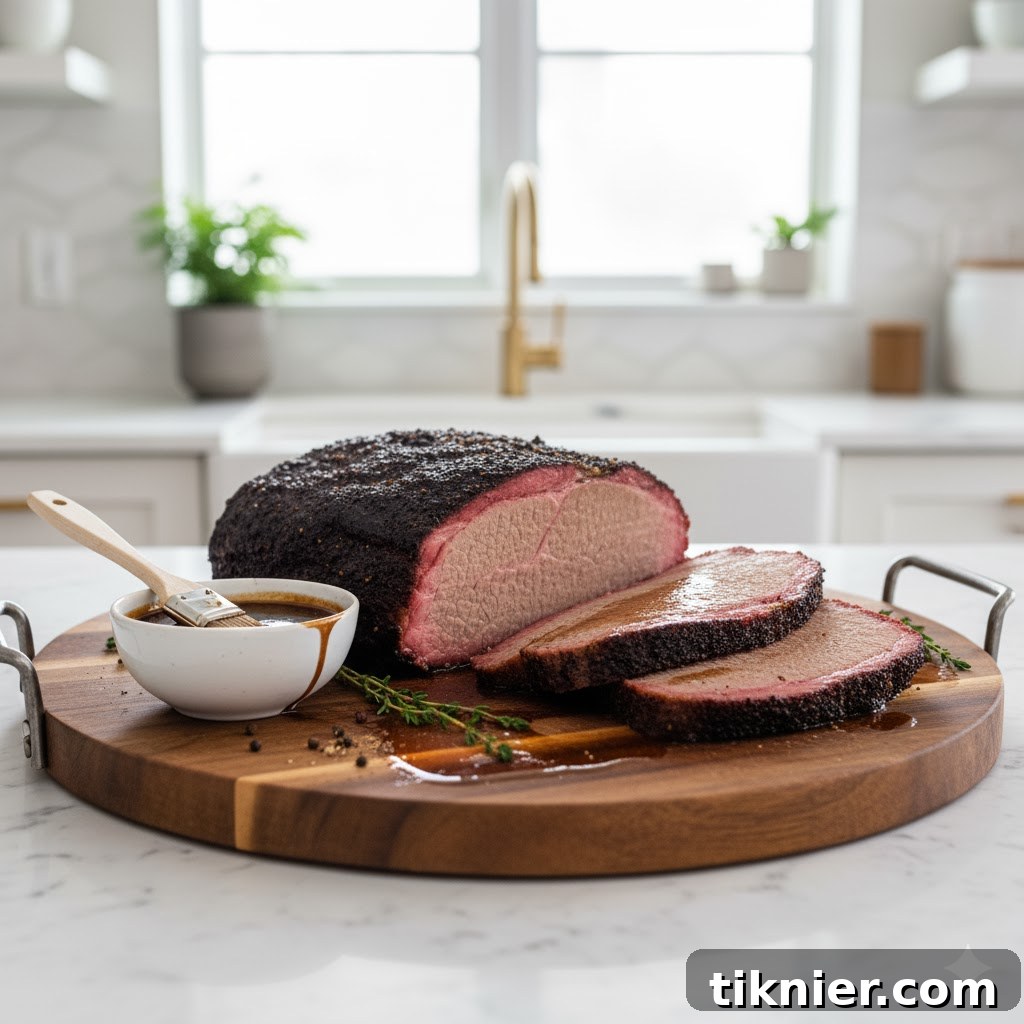
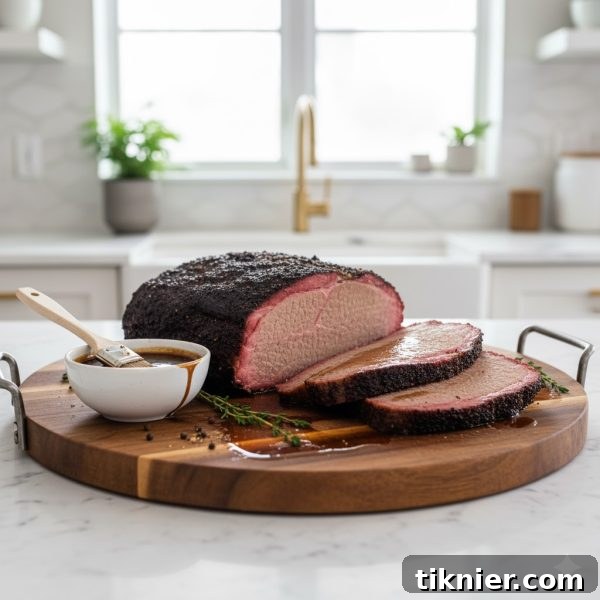
Prepare to revolutionize your weekend smoking experience with this extraordinary espresso-rubbed barbecue brisket. I guarantee it will become your new favorite method for achieving a deeply flavorful and incredibly tender Texas-style brisket.
Growing up, my husband (bless his heart and his staunch adherence to tradition) approached classic Texas brisket with an almost religious reverence. For him, it was always about the purity of salt, pepper, and post oak smoke – nothing more, nothing less. And truly, I hold that tradition in high esteem. However, a part of me has always yearned to infuse a personal touch, to craft a signature flavor that leaves guests wondering, “What secret ingredient makes this so unbelievably delicious?”
The spark of inspiration for this unique recipe ignited during a bustling family gathering a few years ago. It was my turn to orchestrate the main course, and the pressure was palpable. I recalled a remarkably flavorful steak I’d once enjoyed, prepared with a coffee rub, and a metaphorical lightbulb illuminated above my head. Could that profound, roasty essence translate to a slow-cooked brisket, enduring twelve hours of smoke without turning bitter? The idea was bold, but the potential reward seemed immense.
I decided to embrace the culinary adventure. I meticulously blended finely ground espresso into my established chile rub. The moment that brisket hit the smoker, the entire backyard was enveloped in an intoxicating perfume – a symphony of rich coffee, warm spices, and sweet pecan smoke. It was an olfactory masterpiece. When the time finally arrived to carve into that magnificent brisket, the bark presented a stunning, almost dark chocolate hue, promising an explosion of flavor. It was a showstopper even before the first bite. That inaugural slice was nothing short of perfection: impeccably tender, incredibly juicy, and imbued with a deep, savory complexity that far surpassed any traditional brisket I had ever tasted. It quickly ascended to the status of my culinary secret weapon and has, to this day, remained my most requested recipe. This method isn’t just about cooking a brisket; it’s about crafting an unforgettable experience.
Skip to My Special Recipe!
Why This Espresso-Rubbed Barbecue Brisket Recipe Works Wonders
Barbecue brisket holds an undisputed crown in the realm of low-and-slow cooking, a revered Texas tradition that has captivated palates worldwide. At its core, it embodies the art of transforming a notoriously tough cut of beef into something miraculously tender and profoundly flavorful through the deliberate application of patience and smoke. The classic approach, often limited to a simple salt and pepper rub, allows the intrinsic taste of the beef and the aromatic qualities of the wood smoke to truly shine. It’s a beautiful, time-honored technique that consistently yields fantastic results, celebrated by barbecue purists.
Its widespread popularity stems from its position as the pinnacle of barbecue achievement. Brisket cooking is a challenge, a day-long labor of love that generously rewards effort with a meal capable of uniting friends and family. There is an unparalleled satisfaction in carving into a flawlessly cooked brisket, revealing that iconic smoke ring and glistening, succulent meat within. This recipe doesn’t just meet that standard; it elevates it.
So, why introduce a twist to such a perfect tradition? My approach doesn’t aim to supersede the classic but rather to enrich it. The strategic incorporation of finely ground espresso into the rub is the game-changing secret. Far from imparting a coffee-like taste, the espresso serves a more sophisticated purpose. Its inherent earthiness and subtle bitterness act as powerful amplifiers, deepening the savory, beefy notes of the brisket itself. It creates an incredible synergy with the smoky ancho chile and paprika, resulting in a flavor profile that is both familiar and excitingly new.
From a culinary science perspective, the natural acidity present in coffee also contributes to the tenderization of the meat fibers during the extended cooking process. Crucially, the finely ground espresso is instrumental in developing the most exquisite, dark, and crunchy bark imaginable. This deep mahogany crust offers a delightful textural contrast and concentrates a powerful burst of flavor. When paired with a robust, bourbon-spiked braising liquid, this espresso-rubbed barbecue brisket recipe culminates in a final product that is remarkably complex, deeply savory, and truly unforgettable.
Essential Ingredients for the Perfect Barbecue Brisket
The inherent beauty of a truly exceptional barbecue brisket resides in the harmonious convergence of high-quality ingredients with a straightforward, yet precise, technique. While the list of components may appear modest, the deliberate selection of each item will profoundly influence the excellence of your finished product. This is a culinary endeavor where compromising on quality is simply not an option.
The brisket itself, naturally, reigns supreme as the undisputed star. My unwavering recommendation is to seek out a whole “packer” brisket. This comprehensive cut includes both the leaner “flat” muscle and the richer, fattier “point” muscle, offering a spectrum of textures and flavors. When selecting, meticulously look for excellent, uniform marbling dispersed throughout the meat, which indicates tenderness and juiciness. Additionally, ensure a substantial, even layer of fat on the top, known as the fat cap. While a prime-grade brisket promises an exceptional treat, a well-chosen choice-grade brisket will still yield spectacular results when prepared with this particular recipe.
And now, for our distinctive twist: the coffee. It is absolutely paramount to utilize a finely ground dark roast coffee or espresso. The fine grind is critical because it seamlessly integrates into the rub, allowing it to become an integral part of the developing bark rather than feeling gritty. A dark roast is preferred as it delivers that coveted deep, roasty essence without introducing excessive acidity that could overpower the beef. There’s no need to splurge on your most expensive artisanal beans; a good quality, flavorful dark roast coffee will perform admirably.
- For the Brisket:
- 1 (12-15 lb) whole packer brisket, untrimmed, ideally with good marbling
- 1/4 cup yellow mustard (acts as an excellent binder for the rub)
- For the Signature Espresso-Chile Rub:
- 1/2 cup kosher salt (coarse grain for superior bark formation)
- 1/2 cup coarse-ground black pepper (adds texture and classic peppery bite)
- 1/4 cup smoked paprika (enhances smoky depth)
- 3 tablespoons finely ground dark roast coffee or espresso (the unique flavor enhancer)
- 2 tablespoons ancho chile powder (contributes mild heat and earthy notes)
- 2 tablespoons granulated garlic (provides concentrated garlic flavor)
- 1 tablespoon onion powder (rounds out the savory profile)
- For the Bourbon Braising Liquid:
- 1/2 cup rich beef broth
- 1/4 cup quality bourbon (adds complex sweetness and depth)
- 2 tablespoons Worcestershire sauce (umami booster)
- For Smoking:
- Oak or pecan wood chunks (classic choices for beef, offering balanced flavor)
Regarding the other rub components, the choice of kosher salt and coarse-ground black pepper is fundamental for cultivating that characteristic, textured bark. Their larger granules adhere more effectively to the meat compared to their finer counterparts. Furthermore, a high-quality smoked paprika contributes an additional layer of authentic smoky flavor, beautifully complementing the actual wood smoke generated by your smoker.
Step-by-Step Instructions: Mastering the Art of Barbecue Brisket
Crafting a truly magnificent barbecue brisket is a profound labor of love, yet the process itself is remarkably straightforward, emphasizing precision and unwavering patience. By diligently following these steps and trusting the inherent magic of the low-and-slow method, you will be amply rewarded with the finest brisket you have ever created. Resist the temptation to rush, especially during the crucial resting period at the culmination of the cook.
Step 1: Meticulously Prepare Your Smoker
Initiate the smoking process by stabilizing your smoker to a consistent temperature of 250°F (121°C). Regardless of whether you employ a pellet smoker, an offset smoker, or a kamado-style grill, the paramount objective is to maintain an unfluctuating heat environment. Any significant temperature fluctuations can lead to uneven cooking and an inconsistent final product. Now is the opportune moment to introduce your wood chunks, allowing them ample time to begin generating that coveted clean, thin blue smoke. For brisket, I wholeheartedly endorse oak or pecan wood, as they impart a wonderfully balanced and non-overpowering smoky essence that complements the beef perfectly.
Step 2: Expertly Trim the Brisket
This particular step can often feel the most daunting for novice pitmasters, yet it is undeniably critical for optimal results. Your primary goal is to meticulously trim away any excessively hard, waxy fat, as this type of fat will not render down effectively during the extended cook. Aim to leave a uniform, approximately 1/4-inch (0.6 cm) thick layer of the softer, more pliable fat on the fat cap. This precise fat layer serves a dual purpose: it acts as a protective shield for the delicate meat underneath during the long cooking duration and continuously bastes the brisket as it slowly renders. Additionally, remove any silver skin from the meat side and gently shape the brisket to promote superior airflow within the smoker, ensuring an even cook.
Step 3: Precisely Mix the Espresso-Chile Rub
In a medium-sized mixing bowl, combine all the pre-measured ingredients for our signature rub: the kosher salt, coarse-ground black pepper, smoked paprika, the star ingredient finely ground coffee or espresso, ancho chile powder, granulated garlic, and onion powder. Employ a whisk to thoroughly blend all components until the mixture is entirely uniform. This meticulous blending ensures that every single pinch of rub applied to the brisket will deliver the perfect, balanced symphony of flavors.
Step 4: Lavishly Season the Brisket
Begin by thoroughly patting your trimmed brisket completely dry using paper towels. This crucial step significantly aids in the adhesion of both the binder and the subsequent rub. Next, apply a very thin, even layer of yellow mustard over all surfaces of the brisket. Do not be concerned; the mustard flavor will completely dissipate during cooking. Its vinegary base serves as an exceptional binder, helping the rub cling effectively. Now, proceed to generously apply the prepared espresso-chile rub onto every available surface of the brisket. Be liberal with your application, gently pressing the rub into the meat to ensure maximum adherence and flavor penetration.
Step 5: Commence the Smoking Process
Carefully place the fully seasoned brisket onto the smoker grate, ensuring the fat-side is positioned upwards. This strategic placement allows the rendering fat to continuously baste the meat below as it cooks, keeping it moist. Close the smoker lid and allow the gentle, smoky heat to perform its magic for the initial 5 to 6 hours. During this phase, you are observing two primary indicators: an internal temperature hovering around 165°F (74°C) and the development of a dark, firm bark that exhibits no smudging when lightly touched.
Step 6: Navigate the Stall and Wrap with Braising Liquid
This stage is where we effectively power through the notorious “stall” – a point where the brisket’s internal temperature plateaus. Lay out two generously sized, overlapping pieces of heavy-duty pink butcher paper. Carefully transfer the brisket to the center of the paper. In a separate bowl, whisk together the beef broth, bourbon, and Worcestershire sauce. Pour this aromatic mixture evenly over the top of the brisket before proceeding to wrap. This liquid will create a steamy, flavorful micro-environment within the paper, further tenderizing the meat. Wrap the brisket as snugly and tightly as possible, much like meticulously wrapping a cherished present.
Step 7: Achieve Peak Tenderness
Return the meticulously wrapped brisket to the smoker. Continue the cooking process until the internal temperature reaches approximately 203°F (95°C). However, and this is critically important, the true indicator of doneness is texture, not solely temperature. Utilize an instant-read thermometer to probe the thickest section of the flat. The probe should glide in and out with virtually no resistance, akin to effortlessly pushing it into a stick of softened butter. This final cooking phase could span an additional 4 to 6 hours, depending on the brisket’s size and individual characteristics.
Step 8: The Indispensable Resting Period
Under no circumstances should you skip this step! The resting period is the ultimate secret weapon for achieving an unbelievably juicy brisket. Once the brisket reaches probe tenderness, remove the wrapped package from the smoker and immediately transfer it to a dry, empty cooler. Securely close the cooler lid and allow the brisket to rest for a minimum of one hour. For optimal results, I emphatically recommend extending the resting time to 2 to 3 hours if your schedule permits. This extended rest allows the meat’s muscle fibers to relax and, critically, reabsorb all those magnificent, rendered juices, ensuring unparalleled succulence.
Step 9: The Moment of Truth: Slice and Serve
Finally, the culmination of your patience and effort has arrived. Carefully unwrap the brisket on a large cutting board, ideally one equipped with a juice groove to capture any remaining liquid. The aroma alone will be absolutely incredible. Gently separate the point from the flat; this can typically be achieved by locating the distinct, thick layer of fat that naturally runs between the two muscles. Slice the leaner flat against the grain into pencil-thick, uniform slices. The fattier point can be cubed and returned to the smoker for amazing burnt ends, or it can be sliced as well. Serve your masterpiece immediately, ensuring you generously drizzle some of the reserved, flavorful juices from the butcher paper over the top of the sliced meat for an extra layer of moisture and taste.
How To Serve Your Masterpiece Barbecue Brisket
After dedicating countless hours of time, effort, and love to perfecting your barbecue brisket, the serving presentation represents the grand finale. You want to present this culinary triumph in a manner that truly honors the meticulous effort involved and allows the incredible flavor, tender texture, and visual appeal of the meat to command center stage. Often, the simplest approach is the most effective, but there are also numerous imaginative and delightful ways to serve up your smoked masterpiece.
My preferred method for serving this espresso-rubbed brisket is family-style, presented on a substantial wooden cutting board or an elegant platter. I artfully arrange the precisely cut slices of the leaner flat muscle on one side, while the rich, cubed fatty point (often destined to become irresistible burnt ends) occupies the other. This thoughtful arrangement empowers guests to select their preferred cut. Accompanying this main attraction, I consistently feature the revered classic Texas accompaniments: slices of simple white bread, crisp dill pickle slices, and thinly shaved white onion. It’s a timeless combination, and for very good reason—it beautifully complements the rich, smoky flavors of the brisket.
Should you desire further inspiration or wish to construct a comprehensive meal around your culinary masterpiece, here are some of my tried-and-true serving suggestions:
- The Ultimate Brisket Sandwich: Construct an epic sandwich by piling generous slices of warm brisket high onto a soft, buttery brioche bun. Elevate it further with a luscious drizzle of your preferred barbecue sauce, a few tangy pickles, or a creamy scoop of homemade coleslaw right on top for a truly decadent and satisfying experience.
- Gourmet Brisket Tacos: Roughly chop the tender brisket and gently warm it in a skillet. Serve these flavorful pieces in warm corn or flour tortillas, allowing guests to customize their tacos with an array of toppings such as crumbled cotija cheese, vibrant pickled red onions, fresh cilantro, and a bright squeeze of lime for an authentic, zesty finish.
- Loaded Brisket Baked Potatoes: Transform a humble baked potato into a hearty meal. Split a large, fluffy baked potato open, generously slather it with butter and sour cream, sprinkle with shredded cheddar cheese, and then crown it with a lavish helping of chopped brisket. This robust creation is a fulfilling meal in itself.
- Brisket Macaroni and Cheese: Elevate your favorite homemade macaroni and cheese recipe to an extraordinary level by stirring in a cup or two of finely chopped smoked brisket just before baking. The smoky, savory depth of the meat provides a perfect counterpoint and an irresistible match for the creamy, comforting cheese sauce.
Regardless of how you choose to present it, always ensure an ample supply of napkins is readily available. This is a meal that inherently invites enthusiastic enjoyment. Allow the exquisite brisket to remain the star of the show, thoughtfully encircled by simple, yet delicious, sides that perfectly enhance its rich and complex flavor profile.
Storing & Reimagining Barbecue Brisket Leftovers
Let’s be unequivocally honest: having leftover barbecue brisket is a truly delightful problem to encounter. In fact, the subsequent meals crafted from these delicious remnants can often be just as exciting and satisfying as the initial main event. Proper storage is absolutely paramount to ensure that your precious leftovers retain their exceptional juiciness and rich flavor for future culinary creations.
The cardinal rule for storing brisket is to keep it as intact as possible. If circumstances permit, only slice the portion of the brisket you intend to consume immediately. A whole chunk of brisket will invariably retain significantly more moisture than pre-cut slices, preventing it from drying out. For optimal preservation, meticulously wrap the leftover brisket tightly in plastic wrap, then encase it once more in heavy-duty aluminum foil. This robust double-wrap methodology acts as a formidable barrier, protecting the meat from dehydration and preventing it from absorbing any other ambient odors within your refrigerator. Stored in this manner, it will maintain its quality in the refrigerator for up to 4 days.
When it comes to reheating, the philosophy of low and slow is once again the unequivocally superior approach. Vehemently avoid the microwave at all costs, as its rapid, uneven heating will inevitably render the meat tough, stringy, and disappointingly dry. The most effective reheating method involves placing the brisket in an oven-safe dish with a modest splash of beef broth. Cover the dish tightly with foil and gently warm it in a 300°F (150°C) oven until it is thoroughly heated through. This gentle, steaming environment delicately restores the meat’s moisture, ensuring it remains succulent.
Now, for the exhilarating part: ingeniously repurposing those delectable leftovers! Here are a few of my family’s most cherished methods for breathing new life into our brisket:
- Robust Smoky Brisket Chili: Dice the leftover brisket into small, manageable cubes and incorporate them into your favorite chili recipe. This addition introduces an incredible depth of smoky, beefy flavor that simply cannot be achieved with ground beef alone, transforming your chili into a gourmet experience.
- Hearty Brisket Hash for Breakfast: For an absolutely fantastic weekend breakfast or brunch, dice up some brisket and pan-fry it alongside diced potatoes, onions, and colorful bell peppers. Crown this savory hash with a couple of perfectly runny fried eggs for a truly satisfying and immensely flavorful meal that will kickstart your day.
- Quick & Easy Brisket Quesadillas: A perfect solution for a rapid lunch or a simple weeknight dinner. Layer finely chopped brisket and a generous amount of shredded Monterey Jack or cheddar cheese between two flour tortillas. Cook in a skillet until the tortillas are golden brown and the cheese is gloriously melted and bubbly.
- Game Day Brisket Nachos: Elevate your game day spread by arranging tortilla chips on a baking sheet. Top them lavishly with chopped brisket, black beans, thinly sliced jalapeños, and an abundance of your favorite cheeses. Bake until the cheese is bubbly and melted, then serve with cool sour cream, fresh salsa, and creamy guacamole for an unforgettable appetizer.
With just a touch of creativity and culinary imagination, your leftover barbecue brisket can become the gift that keeps on giving, yielding a succession of exciting and delicious meals. Do not hesitate to experiment and discover novel ways to savor every last, precious bite of your hard-earned masterpiece.
Substitutions & Exciting Variations for Your Barbecue Brisket
While I firmly believe this espresso-rubbed barbecue brisket recipe approaches culinary perfection, one of the most gratifying aspects of home cooking is the freedom to personalize a recipe and truly make it your own. There are ample opportunities to subtly tweak both the ingredients and methods to perfectly align with your personal taste preferences or to utilize what you conveniently have on hand. Do not shy away from a little culinary experimentation.
The rub presents the most straightforward starting point for exploration and customization. If the concept of coffee on your brisket feels like a step too audacious, you can simply omit it entirely for a more traditional, yet still exquisitely delicious, Texas-style rub. Conversely, if your palate leans towards a sweeter bark, reminiscent of the popular Kansas City-style barbecue, you can easily incorporate a few tablespoons of brown sugar or turbinado sugar into the rub mixture. This addition will contribute to the formation of a wonderfully sticky, caramelized crust during the smoking process, adding another layer of flavor and texture.
Furthermore, you possess the flexibility to modify the overall flavor profile through alternative spice blends or different wood choices. Here are a few inspirational ideas to commence your journey of customizing your barbecue brisket:
- Wood Smoke Variations: My initial recommendation calls for oak or pecan, which are classic and universally appreciated choices for beef, imparting a balanced and robust smoky essence. For those who crave a significantly stronger, more assertive smoke flavor, mesquite wood would be an excellent, bold option. Alternatively, if you prefer a lighter, subtly sweeter smoke profile, consider experimenting with fruit woods such as apple or cherry wood.
- Braising Liquid Swaps: Should bourbon be unavailable or if you prefer not to use it, suitable substitutions are readily available. A dark beer, such as a rich stout or a malty porter, will contribute a wonderful depth and malty complexity to the braising liquid. For a completely alcohol-free alternative, simply increase the quantity of beef broth, or for a touch of bright tang, a splash of apple cider vinegar can be effectively incorporated.
- Alternative Binders: The yellow mustard primarily serves as an adhesive to help the rub adhere to the meat, and its distinct flavor completely evaporates during the extensive cooking process. If yellow mustard is not at your disposal, a thin, even layer of olive oil, canola oil, or even a flavorful hot sauce can perform just as admirably in binding the rub to the brisket.
- Spice It Up: For those who appreciate a discernible kick of heat, feel free to augment the rub with a teaspoon or two of cayenne pepper or chipotle powder. This addition will infuse the bark with a pleasant warmth that subtly builds with each delectable bite, adding an exciting dimension to the overall flavor.
Crucially, the fundamental technique of low-and-slow cooking, the strategic wrapping to navigate the infamous stall, and the indispensable long resting period will remain effective and essential, regardless of any creative variations you choose to implement. Consider this espresso-rubbed brisket recipe as a robust and versatile blueprint upon which you can confidently build your own unique culinary expressions.
Espresso-Rubbed Barbecue Brisket: The Ultimate Smoked Beef
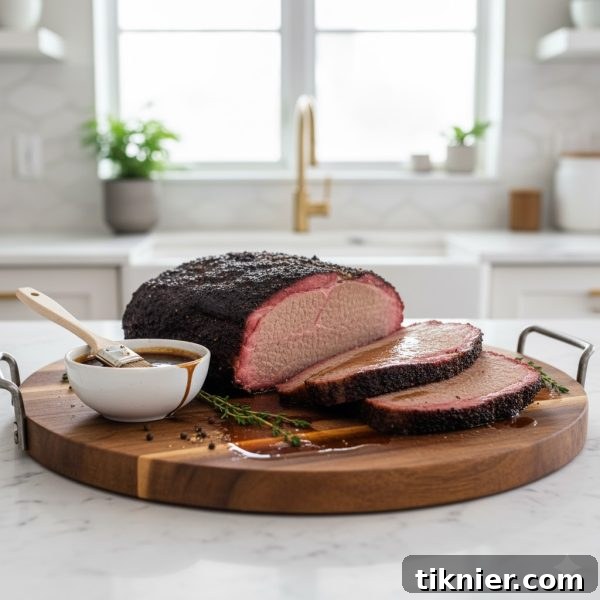
Description: Experience a modern twist on classic Texas-style barbecue brisket. This recipe features a unique espresso-chile rub that develops an incredibly deep, dark bark and delivers a rich, complex flavor profile guaranteed to impress your guests and become a household favorite.
Yield: 16-20 servings | Category: Main Course | Cuisine: American, Southern Barbecue
Prep Time: 30 minutes | Cook Time: 10-12 hours | Rest Time: 1-3 hours
Ingredients
- 1 (12-15 lb) whole packer brisket, untrimmed, quality grade (choice or prime)
- 1/4 cup yellow mustard (as a rub binder)
- 1/2 cup kosher salt
- 1/2 cup coarse-ground black pepper
- 1/4 cup smoked paprika
- 3 tablespoons finely ground dark roast coffee or espresso
- 2 tablespoons ancho chile powder
- 2 tablespoons granulated garlic
- 1 tablespoon onion powder
- 1/2 cup rich beef broth
- 1/4 cup quality bourbon
- 2 tablespoons Worcestershire sauce
- Oak or pecan wood chunks (for consistent, flavorful smoke)
Instructions
- Preheat your smoker to a stable 250°F (121°C) and add your chosen wood chunks to begin producing clean, blue smoke.
- Carefully trim the brisket, aiming to leave a uniform 1/4-inch (0.6 cm) layer of soft fat on the fat cap. Remove any hard fat or silver skin.
- In a medium bowl, combine all the rub ingredients: kosher salt, black pepper, smoked paprika, finely ground coffee, ancho chile powder, granulated garlic, and onion powder. Whisk thoroughly until uniform.
- Pat the brisket completely dry with paper towels. Apply a thin, even layer of yellow mustard over all surfaces, then generously coat the entire brisket with the espresso-chile rub, gently pressing it into the meat.
- Place the seasoned brisket on the smoker grate, fat-side up. Smoke for 5-6 hours, or until the internal temperature reaches approximately 165°F (74°C) and a dark, firm bark has developed.
- Prepare the braising liquid by whisking together beef broth, bourbon, and Worcestershire sauce. Lay out two overlapping pieces of butcher paper. Place the brisket in the center, pour the liquid over it, and wrap tightly, creating a sealed package.
- Return the wrapped brisket to the smoker. Continue cooking until the internal temperature is around 203°F (95°C) AND, more importantly, the brisket is “probe tender” – the probe should slide in and out with almost no resistance. This typically takes another 4-6 hours.
- Remove the wrapped brisket from the smoker and transfer it to a dry, empty cooler. Close the lid and allow it to rest for a minimum of 1 hour, ideally 2-3 hours, to redistribute juices and ensure ultimate tenderness.
- Unwrap the brisket on a large cutting board. Separate the point from the flat, then slice the leaner flat against the grain into pencil-thick slices. Cube the fattier point or slice it as desired. Serve immediately, drizzling with any reserved juices from the paper.
Notes
The resting period is non-negotiable and one of the most critical steps for achieving a juicy, tender final product. Do not rush or skip this vital stage. Patience will be richly rewarded.
Servings: 18 | Calories: 550 kcal | Fat: 40g | Carbohydrates: 2g | Protein: 42g
5 Frequently Asked Questions About Barbecue Brisket
Navigating the world of barbecue brisket can sometimes bring forth a flurry of questions, especially for those new to the art of smoking. Here are concise, yet comprehensive, answers to the most common inquiries I receive regarding this espresso-rubbed barbecue brisket recipe, designed to demystify the process and boost your confidence.
Why is wrapping barbecue brisket in butcher paper considered a beneficial step?
Wrapping a brisket, a technique affectionately dubbed the “Texas Crutch” by barbecue enthusiasts, is a critical intervention employed for several strategic reasons. The primary motivation is to assist the brisket in pushing past a phenomenon known as “the stall.” During the stall, the meat’s internal temperature inexplicably plateaus for several hours, causing considerable anxiety for aspiring pitmasters. Encasing the brisket in butcher paper ingeniously traps a crucial amount of steam and humidity around the meat. This creates a slightly more humid micro-environment, which, in turn, helps to elevate the brisket’s internal temperature, allowing it to power through this frustrating stall phase much more efficiently and quickly.
You might reasonably ponder why butcher paper is favored over its more common counterpart, aluminum foil. While foil is indeed effective and widely utilized, it possesses a notable drawback. Foil is entirely non-porous, meaning it traps *all* the generated steam. This intense steaming effect can inadvertently soften the magnificent, crusty bark – that coveted outer layer – which you painstakingly developed during the initial smoking phase. Pink butcher paper, conversely, is intentionally breathable. It allows just enough moisture to escape, preventing the bark from becoming soggy, while still retaining sufficient humidity to facilitate the cooking process. It truly offers the best of both worlds: protecting the meat from drying out while preserving that perfect, flavorful bark texture.
What exactly is the “stall” when smoking a barbecue brisket?
The “stall” is a perfectly normal, albeit sometimes exasperating, phase inherent in smoking any substantial cut of meat, such as a large brisket or a pork butt. It typically manifests when the internal temperature of the meat reaches a range of approximately 150°F to 165°F (65°C to 74°C). At this precise juncture, the temperature can stubbornly hold steady for several hours without any perceptible increase, a phenomenon that frequently triggers significant concern and doubt among those new to barbecue cooking.
The scientific explanation behind this puzzling plateau is remarkably straightforward: it’s primarily due to a process called evaporative cooling. As the brisket gradually heats up, it begins to expel a significant amount of moisture from its expansive surface. This moisture then evaporates, and the act of evaporation inherently creates a cooling effect, much in the same way that perspiration cools the human body on a hot day. Essentially, the brisket is “sweating,” and this continuous cooling effect actively battles against the sustained heat emanating from your smoker. Once a sufficient quantity of that surface moisture has evaporated, the brisket’s internal temperature will eventually begin its upward climb once more. Wrapping the brisket, as previously discussed, is an effective strategy to mitigate this cooling effect and significantly accelerate the cooking process through the stall.
How can I definitively determine when my barbecue brisket is genuinely done?
This question is arguably the most pivotal in the entire lexicon of brisket preparation. While temperature serves as an invaluable guide, it should not be regarded as the ultimate, unyielding rule. I consistently advise cooks to aim for a target internal temperature of around 203°F (95°C), but the true, unequivocal indicator of doneness is tactile: you are seeking the brisket to be “probe tender.” This signifies that when you gently insert the probe of an instant-read thermometer into the thickest part of the brisket’s flat, it should glide in and out with minimal to no discernible resistance. The sensation is frequently likened to effortlessly probing a stick of room-temperature butter or smoothly pushing into a jar of soft peanut butter.
It’s important to remember that every individual brisket possesses its unique characteristics. Some briskets may achieve perfect tenderness at 198°F (92°C), while others might require reaching 205°F (96°C) or even slightly higher. This variability exists because you are not merely cooking the meat; you are fundamentally transforming vast quantities of tough connective tissue (collagen) into succulent, silky gelatin. It is precisely this magical biochemical transformation that endows brisket with its characteristic tenderness and incredible juiciness. The “probe tender” sensation is the unmistakable sign that this desired metamorphosis has fully transpired. Always prioritize the feel of the probe over a strict adherence to the thermometer’s numerical reading.
Is it possible to prepare this barbecue brisket in a conventional oven?
Indeed, you can certainly cook a brisket in a conventional oven, and while the resulting product will inherently differ from one meticulously smoked in a dedicated barbecue smoker, you can still achieve a remarkably delicious and tender outcome. The most significant element you will inevitably miss is the authentic, complex smoke flavor derived from real wood. To mitigate this absence, you will need to heavily rely on ingredients that are capable of imparting a smoky essence. The inclusion of smoked paprika in the rub becomes absolutely essential, and you could even consider adding a few judicious drops of liquid smoke to the bourbon braising liquid to further enhance that desired flavor profile.
To prepare the brisket in the oven, meticulously follow the seasoning instructions exactly as outlined in the recipe. Place the prepared brisket on a rack positioned inside a sturdy roasting pan and cook it in a preheated 275°F (135°C) oven until its internal temperature reaches approximately 165°F (74°C) and the bark has visibly set. Subsequently, introduce your braising liquid to the bottom of the roasting pan, meticulously cover the pan tightly with aluminum foil, and continue baking until the brisket registers as “probe tender.” While you will forego the unique and irreplaceable flavor nuances that only genuine wood smoke can provide, the robust espresso-chile rub and the steadfast low-and-slow cooking methodology will nonetheless yield an incredibly palatable and tender piece of beef.
Is allowing the barbecue brisket to rest after cooking truly necessary?
Yes, unequivocally, and with absolute certainty—one hundred percent. The resting period is arguably one of the most critical and non-negotiable steps in the entire brisket preparation process, and regrettably, it is the step most frequently overlooked or prematurely curtailed by impatient cooks. During the extended duration of the cooking process, the muscle fibers within the meat undergo a tightening contraction, effectively squeezing much of their precious moisture towards the surface. If you were to immediately slice into the brisket straight out of the smoker, all of that beautifully rendered fat and succulent juice would unceremoniously spill out onto your cutting board, leaving you with dry, tough, and ultimately disappointing meat.
Allowing the brisket to rest facilitates a gradual reduction in its internal temperature. This controlled cooling permits the muscle fibers to relax and, critically, to reabsorb all of that invaluable moisture, redistributing it evenly throughout the entire cut. This fundamental process is precisely what guarantees that every single slice of your brisket will be incredibly juicy, tender, and bursting with flavor. A minimum resting period of one hour is an absolute mandate, but for a brisket of this substantial size, an extended rest of 2 to 3 hours within a dry, insulated cooler is considered ideal. Rest assured, the brisket will remain perfectly warm for serving. Patience exercised during this crucial resting phase will be rewarded tenfold in the superior quality of your final product.
Explore More Culinary Adventures with These Recommended Recipes
Once you’ve expertly mastered the art of this espresso-rubbed barbecue brisket, your culinary confidence will undoubtedly soar, preparing you to embark on even more delightful kitchen projects. If you thoroughly enjoyed the depth of flavor and satisfaction derived from this recipe, I am confident you will adore some of the other cherished favorites from This Gal Cooks. Here are a few excellent starting points for your next exciting cooking escapade, designed to continue your journey through delicious and rewarding culinary experiences.
For those bustling weeknights when the commitment of a twelve-hour smoke is simply not feasible, having a repertoire of quick and dependable meals is essential. This curated collection of easy dinner ideas is brimming with family-friendly recipes that come together in a flash, without ever compromising on incredible flavor or quality.
110 Easy Dinner Ideas That Taste Great: Quick & Delicious Weeknight Meals
Brisket, with its impressive size and rich flavor, makes an unforgettable centerpiece for any grand holiday meal. If the thought of such large-format entertaining has sparked your interest, then you absolutely must explore my comprehensive Thanksgiving guide. It is meticulously compiled with everything you need, from show-stopping main courses to all the beloved classic sides and decadent desserts, ensuring you can orchestrate the perfect, most memorable feast.
Ultimate Thanksgiving Dinner Ideas: Recipes for a Perfect Holiday Feast
One of the many hidden benefits of preparing a large brisket is the abundance of delicious leftovers, which can be ingeniously transformed into a myriad of fantastic and budget-friendly meals. If you appreciate the art of making your ingredients stretch further, you will discover a wealth of inspiration within this roundup of cheap meal ideas, all designed to be satisfying, economical, and utterly delicious.
Cheap Meal Ideas: 80+ Budget-Friendly Recipes for Everyday Savings